Factors That Affect the Link Juice - Internal and External
Not all links transmit the same quantity of link juice. Some links are authoritative, transferring a lot of link juice, while others are not worth much. Such factors can be internal as well as external in nature.
Let us understand these factors in detail.
Internal Factors That Affect Link Juice:
“Internal” links refer to the links that are generated between pages of your own website to the other pages of the website. The main purpose of these links is the spread of the “Link Juice” or to inform the search engine about your important pages.
1. Website Architecture
Website architecture, also known as site architecture or link architecture, deals with the structure of your website pages. A website that is organized allows link juice to flow easily. The more your important pages are accessible from the home page, the more link juice your pages will receive. Consequently, your webpage will have good SEO results
2. Number of Internal Links on a Page
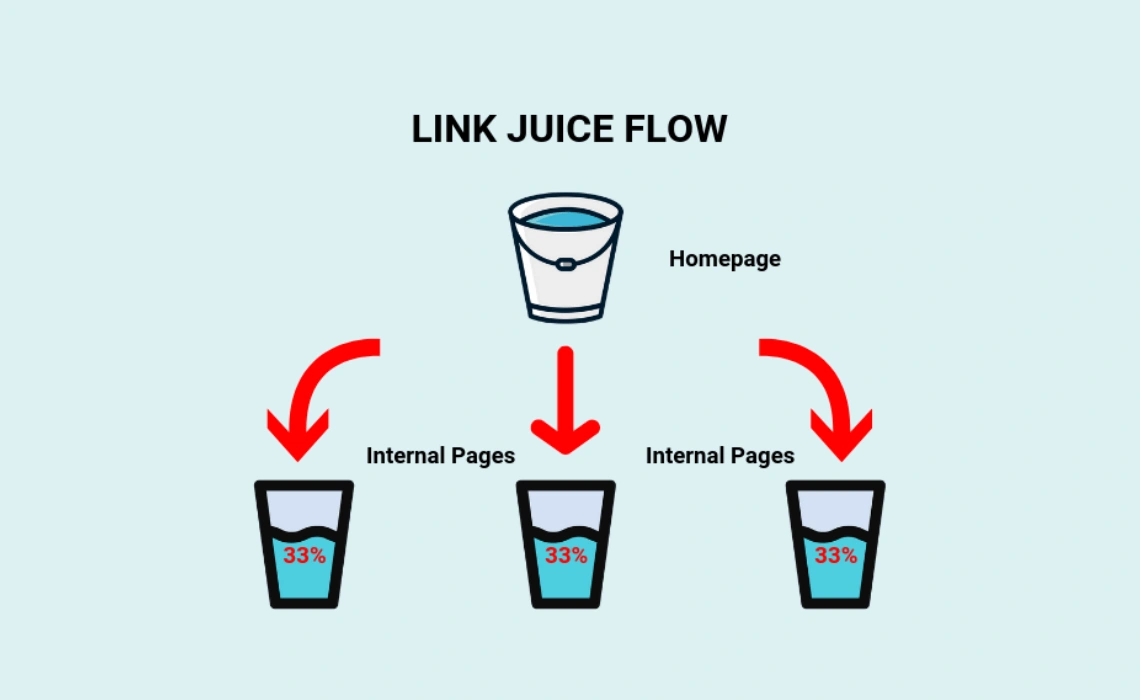
The number of internal links on a page shapes the distribution of link juice. When a page has numerous internal links, this limits the amount of available link juice that is shared with these internal links. However, this leads to less concentrated link juice on individual linked web pages. This approach allows less internal linking, which provides greater concentrated link juice on other recognised or important web pages.
3. Anchor Text Used in Internal Links
The anchor text is the Clickable Text that users use to form links. The anchor texts play a critical role in making the search engines aware of the importance and context of the pages they are linking to. When descriptive anchor texts are used, the search engines can more easily ascertain the context and relevance of the other linked pages.
4. Page Authority Within Your Website
Not all pages in a website enjoy equal authority. Pages that are already performing well, for example, the homepage and popular blog entries, tend to have a higher authority. Pages linking to other pages using higher authority pass greater link juice, and low-traffic pages, relatively less.
5. Canonical Tags
Canonical URLs are employed when there are several URLs that have similar or duplicate content. These URLs inform search engines which URL should essentially act as the canonical page. In this manner, the canonical URL aggregates the link juice corresponding to the duplicate URL. As a consequence, the SEO juice is not distributed.
External Factors That Affect Link Juice:
External links, which are also recognised as backlinks, are obtained from other websites. These links contribute largely to search engine optimisation, though they rely on several factors for the quantity of link juice.
1. Authority of the Linking Website
The quality of the authoritative website linking to you can greatly affect the value of the link juice you receive. Links from reputable and trustworthy websites are valued more. When an authoritative site gives a hyperlink to your web page, search engines believe your page is trustworthy and credible.
2. Relevance of the Linking Site
Relevance is also crucial in determining the flow of link juice. Getting a link from a site that is relevant to your niche is much better than acquiring a link from a site that is not at all connected to what you are offering or talking about. When the sites are relevant, it gets beneficial in terms of link juice.
3. DoFollow vs NoFollow Attribute
DoFollow links enable the passage of link juice between sites. These are useful in increasing search rankings directly. NoFollow linking does not contribute significantly to SEO in general because they don't pass SEO/link juice. But they have other uses like increasing visibility and driving traffic.
4. Number of Outbound Links on the Linking Page
If the page is linking to lots of different sites, the link juice is divided among these links. The effect of the link juice is diluted as a result. Pages with fewer links get more powerful link juice to deliver.
5. Placement of the Backlink
The location where a backlink is placed also influences link juice. If backlinks are placed where the content is, these backlinks tend to pass more link juice as they are relevant to content. Those placed in footers or sidebars tend to pass less SEO juice.
6. Anchor Text of the Backlink
The anchor texts in backlinks are used by Google to recognise the content of your web page. The quality of your anchor text affects the flow of link juice to your site. However, your anchor texts might negatively affect Google if they are spam.